
From Top Dead Center to the Golden Phase of Gait
Part I — Ignition Advance and Retard: Delivering Force at the Golden Moment
At the core of every four‑stroke engine lies a seemingly simple but profoundly important principle: force is only useful when it is delivered at the correct moment.
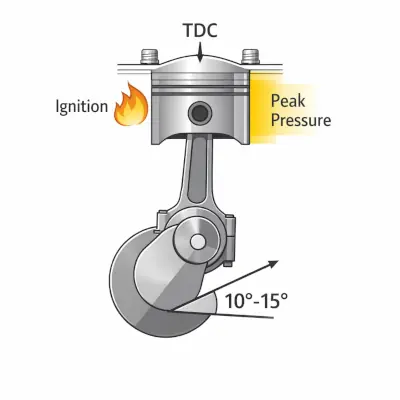
The engine is not concerned with the spark itself, nor with the explosion—it only “cares” that the peak cylinder pressure occurs just after the piston passes Top Dead Center (TDC) and begins its power stroke. Many powertrain engineers refer to this point as the “golden zone” of combustion phasing, the moment when chemical energy is converted into crankshaft torque with maximum efficiency.
Because gasoline does not combust instantaneously, engineers must trigger the spark before the piston reaches TDC. This intentional early ignition is known as Ignition Advance. It allows the flame front to propagate, pressure to build, and peak pressure to align with the optimal crank angle window immediately after TDC.
The result:
- more power
- less fuel consumption
- proper thermal behavior
- longer component life
What happens if peak pressure occurs before TDC?
Excessive ignition advance causes peak pressure to develop while the piston is still rising, creating a destructive condition known as negative work or combustion opposing piston motion. This leads to:
- severe knock and higher risk of piston, valve, or head damage
- reverse loading on the crankshaft and connecting rod
- excessive heat generation
- poor efficiency and increased fuel consumption
In essence, part of the combustion energy is wasted fighting the engine itself.
What if pressure peaks exactly at TDC?
This is mechanically the worst scenario. At TDC the piston has no mechanical leverage to transmit force to the crankshaft, so pressure becomes a pure axial shock load.
Consequences include:
- rod bending
- sudden bearing loads
- crankshaft hammering
- increased probability of piston failure
Since this produces no useful work and introduces dangerous stresses, engineers avoid this point entirely.
What if pressure occurs too late?
Late combustion — excessive retard — means the piston is already moving downward when pressure finally builds. This results in:
- reduced effective force
- lower power output
- increased fuel usage
- elevated exhaust gas temperature (EGT)
- overall poor thermal efficiency
Thus, neither too early nor too late is acceptable. In engines, the correct point typically places peak pressure 10°–15° after TDC.
Part II — Running Biomechanics: The Golden Phase of Force Application
Interestingly, the human body faces the exact same problem during running: force must be applied at the right moment to generate efficient forward propulsion. Running is a continuous cycle of force management, combining energy storage, release, and interaction with the ground. Just as an engine must phase pressure correctly, a runner must time their force application precisely.
The right moment to apply force
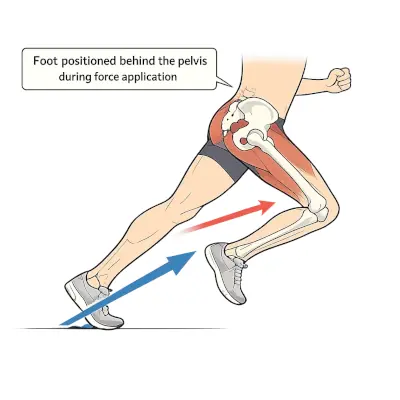
In efficient running mechanics, the foot should be slightly behind the hip at the moment of push‑off. In this position, the ground reaction force vector is oriented optimally to generate forward momentum. When the foot is just behind the hip:
- energy is directed forward
- propulsion increases
- muscles operate efficiently
- fatigue decreases and running economy improves
This is the biomechanical equivalent of the engine’s “golden zone.”
What if the foot applies force too early (in front of the hip)?
This is biomechanically analogous to excessive ignition advance:
- the body experiences braking forces (overstriding)
- impacts on the knee and hip increase
- forward velocity drops
- muscle engagement becomes delayed and inefficient
- fatigue rises
Part of the runner’s force is used to counteract their own forward motion, just like an engine fighting itself.
What if force is applied directly under the hip?
This resembles peak pressure exactly at TDC:
- vertical loading on the spine increases
- the knees absorb more impact
- propulsion decreases; vertical motion increases
- stride length and efficiency decrease
As in engines, this moment produces load without productive forward work.
What if the foot applies force too late (far behind the hip)?
This corresponds to excessive retard:
- the posterior chain overworks
- hamstring strain risk rises
- stride efficiency drops
- forward speed decreases
Force is no longer delivered during the optimal propulsion window.
Thus, just like an engine, running has its own “golden phase”: effective force must be applied just after the hip passes over the stance foot.
Part III — The Deep Parallel Between Ignition Timing and Running Timing
Viewed casually, ignition timing in engines and force timing in running appear unrelated. But fundamentally, both systems depend on the same concept:
Force is only useful when applied at the right time — not too early, not too late.
What does ignition advance accomplish?
The spark occurs before TDC so that the useful rise in pressure occurs after TDC. A deliberate early event to create the desired mechanical effect later.
What is the equivalent in running?
The foot must be placed correctly before the moment of propulsion:
- foot strike often occurs slightly in front of or under the hip
- but push‑off must occur after the hip passes over the stance foot
This matches engine timing perfectly:
- foot strike = spark event
- push‑off = peak pressure phase
In engines, a late spark yields late force; in running, a late push-off wastes energy.
In engines, an early spark causes knock; in running, early force application causes braking.
Conclusion
In both systems — mechanical and biological — timing outranks magnitude.
Engines use advance and retard to phase combustion correctly.
The human body uses foot placement and hip mechanics to phase propulsion correctly.
Too early creates destructive loading.
Too late wastes energy.
Perfect timing maximizes efficiency.